 Studios Xenia
CryptoXenia: a quantitative lab that won't trade without evidence
In-house project · demo account, no real money
CryptoXenia is our quantitative engine for EUR/USD on MetaTrader 5. It runs on a demo account, with no real money, and it has one rule: nothing runs blind. What this case shows is the engineering: a ledger that cannot be rewritten, a «shadow» that runs it 24/5 on a remote server and 2,662 automated tests guarding every change.
- 2,662passing automated testsSource: full suite, 5 Nov 2026
- 601/622mutants caught; the other 21 are equivalentSource: AST mutator, 5 Nov 2026
- 24/5shadow on a remote server, watchdog every 15 minSource: project log, Nov 2026
- 0blind orders: nothing trades without passing its testSource: project rule
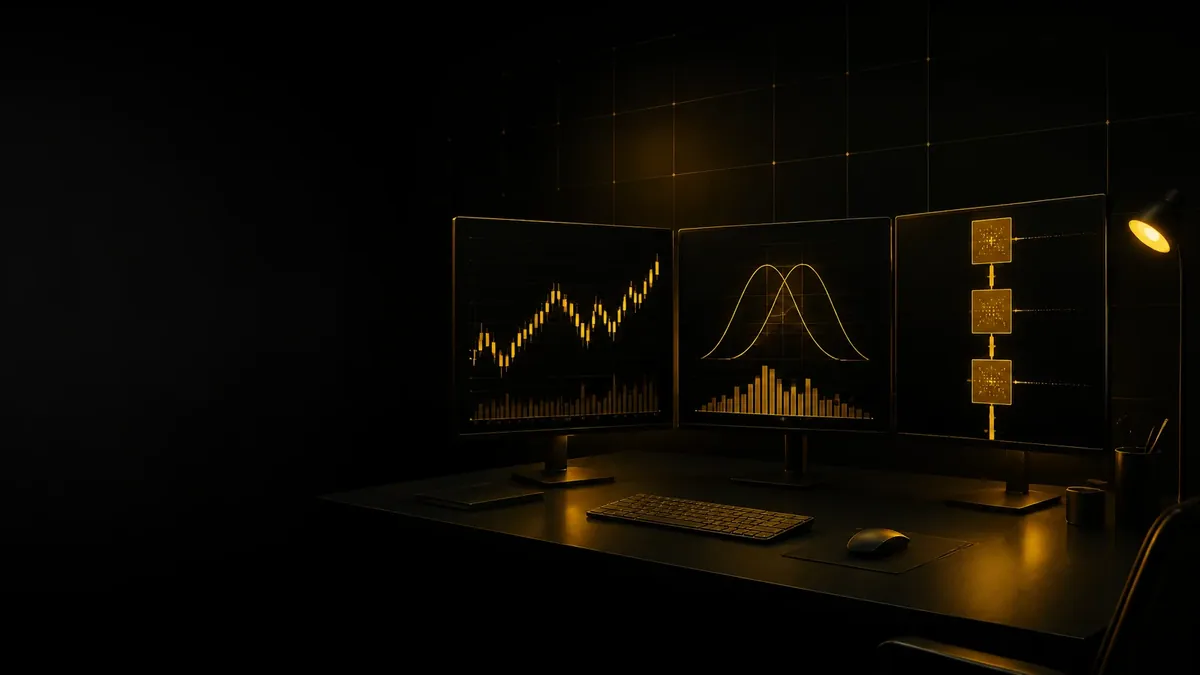
Own project · illustration and real numbers · See the case study
On the workstation
- MetaTrader 5candles and a demo account
- Bridgereads, validates, never repeats orders
- Strategy and riskfixed lot, −3% daily, news filter
- Tamper-evident ledgerSQLite with locks and a fingerprint chain
Remote server
- 24/5 shadowthe full system, without orders
- Watchdogevery 15 min: restarts and alerts
- Daily copyverifies the chain and freshness
- Read-only portalchart, log and studies
Lab
- Hypothesisregistered with its fingerprint first
- Evaluationfalse positives controlled at 5%
- Blind segmentdata nobody looked at
- Decisionif it fails, it doesn't trade
- 2,662passing automated testsSource: full suite, 5 Nov 2026
- 601/622mutants caught; the other 21 are equivalentSource: AST mutator, 5 Nov 2026
- 24/5shadow on a remote server, watchdog every 15 minSource: project log, Nov 2026
- 0blind orders: nothing trades without passing its testSource: project rule
The challenge
A trading engine is the worst place for «it works on my machine». It decides on its own, at any hour, and a mistake costs money. We framed it as a system that can be audited: every decision written down, nothing running without a statistical test written before looking at the data, and code that doesn't break when it changes.
What we built
A MetaTrader 5 bridge with small-account risk
A bridge that reads candles and account state, with hard risk rules: a fixed lot below a certain balance, a 3% maximum daily loss and a filter that won't trade 15 minutes before or after high-impact news.
A ledger that cannot be rewritten
Every movement lives in a SQLite database with locks inside the database itself: a row is never edited or deleted, only corrected by another row that names it. Each row carries the fingerprint of the previous one, like a chain, and the tip of the chain is also recorded outside the system. If someone changes an old row, the chain gives it away. You can try it below.
The shadow: the full system, without orders
A copy of the engine runs 24/5 on a remote server and does everything except send orders. A watchdog checks it every 15 minutes and restarts it if it falls; every morning a task pulls a copy of the ledger, verifies the whole chain and alerts if something doesn't add up or if the data arrives late.
A lab that doesn't fool itself
Each hypothesis is registered with its fingerprint before looking at the data that will judge it, false-positive control (Benjamini–Hochberg at 5%) was calibrated with noise and part of the data stays blind until the end. If an idea doesn't pass, it doesn't trade.
On the workstation
- MetaTrader 5candles and a demo account
- Bridgereads, validates, never repeats orders
- Strategy and riskfixed lot, −3% daily, news filter
- Tamper-evident ledgerSQLite with locks and a fingerprint chain
Remote server
- 24/5 shadowthe full system, without orders
- Watchdogevery 15 min: restarts and alerts
- Daily copyverifies the chain and freshness
- Read-only portalchart, log and studies
Lab
- Hypothesisregistered with its fingerprint first
- Evaluationfalse positives controlled at 5%
- Blind segmentdata nobody looked at
- Decisionif it fails, it doesn't trade
How it's tested
The full suite had 2,662 passing tests on 5 November 2026. On top of that, a syntax-tree mutator generated 622 broken versions of the code: the tests caught 601, and the remaining 21 are equivalent, each with its reason written down. There are torture tests that kill the process mid-write and prefix tests against look-ahead bias.
Try it: a chain that gives away any change
Each row stores the SHA-256 fingerprint of its content together with the previous row's fingerprint. Change one letter in any row and watch the chain break from there down. Your browser computes it live; the data is sample data.
Needs JavaScript to compute the fingerprints.
What it means for your company
The same rigour works for a collections system, an operations dashboard or a WhatsApp agent: a log nobody can alter unnoticed, processes that recover on their own and tests that stop you breaking what already works. That's what we offer in custom apps and software.
Solutions related to this case
- Custom software developmentPrivate dashboards, installable apps and in-house engines, quoted by scope with published tests.
- Software for industrial companiesPrivate dashboards and automatic follow-up for companies that quote, invoice and coordinate in the field.
Keep reading
- Hato: a livestock app that works with no signal on the plainsOffline, chute work with tag reading, health and SIGESAI.
- B2B prospecting engine: find, verify, write and alertFinds, verifies, writes and stops itself.
- This website: from a heavy app to 388 pages that load instantlyFrom between 3.6 and 6.1 s to 1.2 s on a slow phone.